


Paul The Tentmaker
Paul The Tentmaker
Paul, The Tentmaker
Tentmaking Was Practical
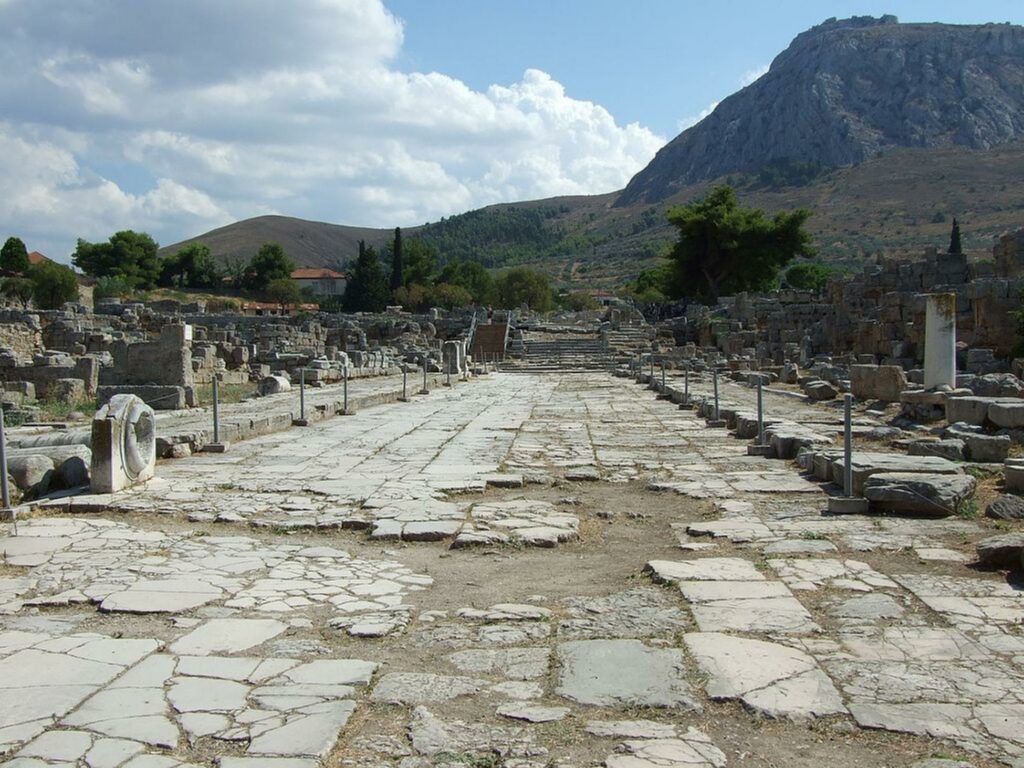
This is the Lechaion Road today
Paul Turned Away Donations?
But there was a pastoral aspect as well. The city of Corinth, in common with many Roman cities, had a well-developed patron-client system. The patron-client system was all about status. Patrons were higher status, wealthier people, and clients were their followers. In exchange for free meals, the clients followed the patrons around, went with them to court to support their many lawsuits against one another, and generally added to their patron’s prestige. What no one wanted to do was actually work. If you read Paul’s Corinthian correspondence, you’ll see that he actually refused to take money from the Corinthians who wanted to give him money! That’s because he didn’t want to be seen to participate in the patron-client culture as either patron or client. They would have misunderstood the relationship if he had taken money from them.
It’s noteworthy that Paul did indeed receive patronage from someone in the region though. In Romans 16:2, Paul commends a deacon of the church in Cenchrea, a small city very near to Corinth. Her name is Phoebe, and Paul says that she’s been his patron and the patron of many. It’s pretty clear that Phoebe did not misunderstand the relationship, so Paul was able to receive her support. He even trusted her to deliver and perhaps to explain the epistle to the Romans as well.
Tentmaking As Counter-Cultural Witness
The other place where we know that Paul worked to support himself is Thessalonica. In 1 Thessalonians 2:9 Paul mentions that while he was with them he worked night and day so that he wouldn’t be a burden to them. Later, in 1 Thessalonians 4:11-12, Paul writes to them to live a quiet life, mind their own business, and work with their hands so that they won’t be dependent on anyone. This is likely a reference to the patron-client system or similar. Paul didn’t want them to sell their support to the highest bidder. He wanted them to do something useful in the world. His motivation in supporting himself among them was to provide them with an example of what it is to be a Christian. He was showing them how to live as a kingdom person, which was, and is, very different from following the ways of the world.
So What Kind of Missionary Are You?
So when we’re deciding whether to be a missionary “on support” or a “tent making” missionary, our motivation needs to be a kingdom motivation. We have to think about our own cultural background and the cultural background of the nation we’re called to. Our considerations should be both practical and spiritual in nature.
If our culture looks down on asking for support, that’s probably the exact thing we most need to do. The kingdom of God is about giving and receiving, not about buying and selling. By providing people with an opportunity to sow seeds of generosity, we oppose something important in a culture that is fixated on buying, selling, and getting. By choosing to live with less, we witness to what is most important. Not that there is anything wrong with working a paid job! But there is something powerful about the witness of people who have chosen to receive generosity so that they can give freely to others.
It’s All About Discipleship
If we’re seeking to disciple Christians in a nation that is averse to working with their hands, there is something very powerful about tent making, but it had better be a “working with your hands” kind of tent making. If we want to disciple people in being honest in business, then running a business honestly would be a powerful testimony. If you want to show the relative merits of various priorities, choosing less status at work in order to prioritize your family might be the way to go.
As Christians, we need to think very deliberately about what our lives say about who God is and how his kingdom works.
Paul The Fundraiser
In the next post in this series, we’ll talk about when Paul received, and even asked for, financial support.
If you have further questions, you can contact us on our website here: About Us | Who Is Pacific Reach? | YWAM Pacific Reach New Zealand
Or we’ve written another blog post with more details on the topics we teach during a DTS – YWAM DTS Lecture Topics.


“Doing SPHC was an amazing experience. Not only was I given the opportunity to continue to grow spiritually, but I learned things that can be used in a very practical and much needed way. SPHC gave me the opportunity to show the Father’s heart to people in a very unique way and love on the person in front of me while helping them in such a simple way.”
Karunia Been, 20, Portugal

“I’ve learn what the Kingdom means for us, how can we bring the Kingdom here and just share it with others… That makes me super excited! The key is to listen to God’s voice, seek His face and His presence! Everything else will be added as he promised is Matthew 6:33!”
Estera Welchar, 22, Poland

“At the beginning of the DTS I did not believe in the power of prayer neither did I believe that God even heard my prayers. By the end of it I had no doubt in my mind at all that we have a Father in heaven who always bends His ear to us when we speak and that when we pray in the name of Jesus miracles will be birthed by our words and God’s power.”
Calvin Joubert, 20, South Africa

“Being part of the Wild Heart stream helped me know my place in the kingdom as well as parts of my spiritual identity. It broke lies and empowered me to be who God called me to be!”
Nicole Tavares, 18, Brazil
“Coming into the medical compassion stream, I thought it would just be an addition to my medical experience. But after laying down my expectations I was able to grasp the essence of compassion through ministry, experiencing a new perspective on medicine. Choosing to serve in love, and taking the time to seek out and care for the one who need it most.”
Yekaterina Lukyanchina, 20, Russia/America

“Before joining the Medical Compassion stream, it was hard for me to understand what total surrender looked like in my life. I realize now that it is not my own compassion that compels me to love and care for others, but rather, it is the Father’s heart through me. I realize now that He is the true Savior, and I am simply a vessel chosen to carry His love and mercy to those hurting around me.”
Maeve Cooney, 18, Maryland, USA

“Being a part of the Pilgrimage Stream impacted my life for the better. Not only did it teach me how to function in a small community (as we shared the burden of climbing those mountains together), but also how to rely on one another, have fun and worship together, and, most importantly, how to be vulnerable with each other. The focus of our Stream taught me what it looks like to be on a pilgrimage for God. God calls us out of our homes to the wilderness, where we’ll see Him face-to-face, and are forced to fully depend on Him before we receive His inheritance.”
Harty Dumalagan, 21, B.C. Canada
“Our outreach to the Cook Islands taught me how to enjoy the simplicity of life. I learned that God is always focusing on my heart first and then on the hearts of other people. God also showed me the importance and power of constantly being in prayer.”
Judith Evers, 20, Germany

“This is the craziest stream ever, not just doing fun activities, but the people I was with; they are wild as! Throughout the school, I’ve learned so much from the Bible that doing life with God and living my life on the edge is so much more interesting.”
Mun Hei, 21, Malaysia

“Being apart of Wild Heart has really helped me find out what it means to be wild for God. It has helped me break out of shells I didn’t even I know had. The stream transformed my way of thinking when it comes to being a disciple of Christ, teaching me to take action in faith. It has given me many things I will be able to take home and apply in my daily life, crazy awesome!”
Deylan Santy, 19, Idaho, USA